
Dionysiac Left-Nietzscheanism in Power: In Defence of the Fiume Commune
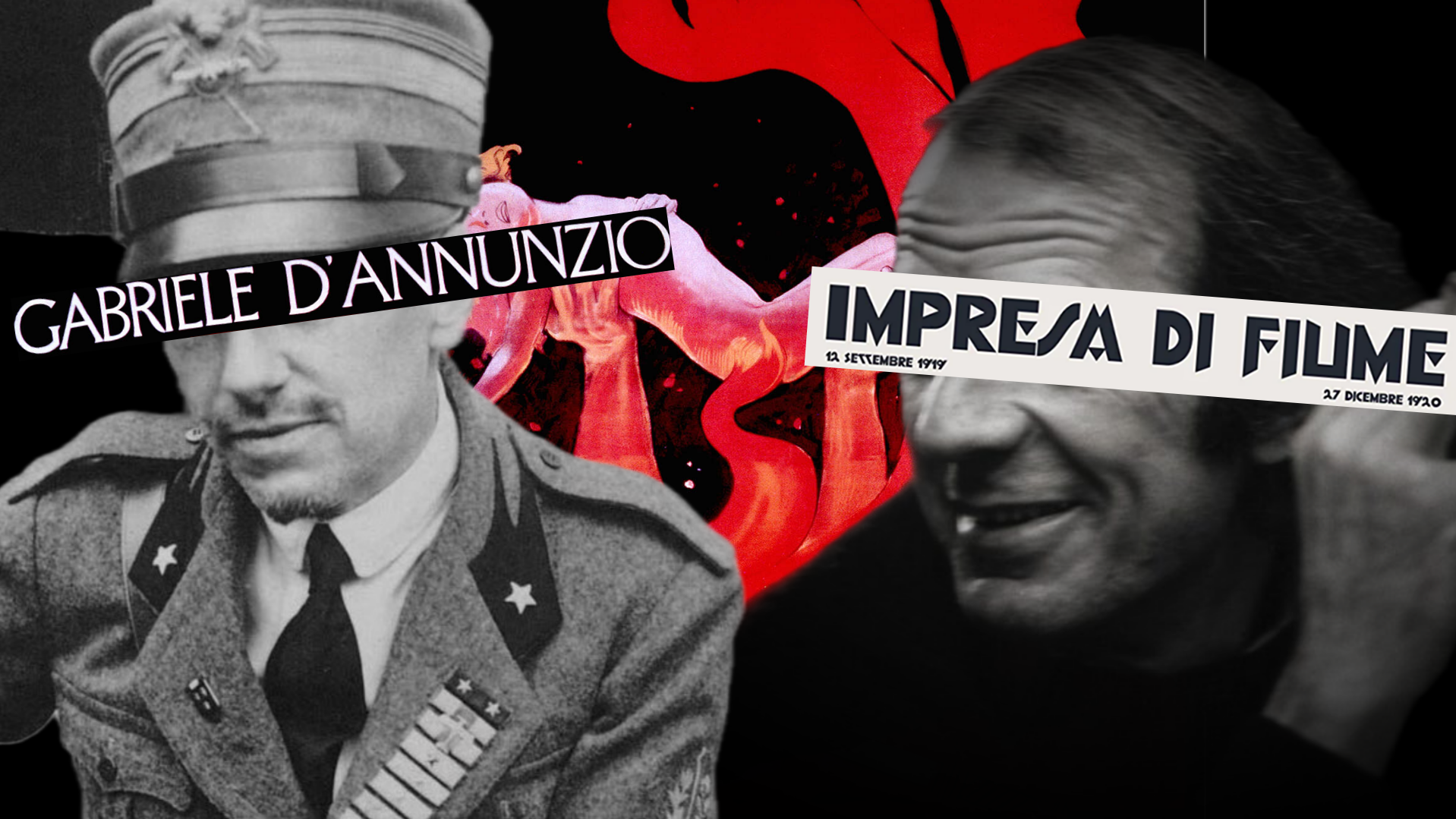
The Fiume Commune
It is 1919, and legendary poet and war hero Gabriele D’Annunzio, alongside his rag-tag group of veterans, seizes the contested city of Fiume, driven by nationalist fervor, to annex it for Italy. In History, which is fundamentally contingent with each passing moment, nothing ever quite works out how it was intended. What follows is one of the most ambitious anarchist social experiments of the 20th century, lasting for 15 months, in what became known as the ‘Fiume Commune’, before being brought to an abrupt end by the Italian State’s bombing campaign in 1920.
The Fiume Commune has somewhat of a cult following in anarchist circles, but it is kept quiet because of its supposed association with what would later become fascism. This is a revisionist view of history. There is a need to re-contextualize the events of the late 1910s, in order to unearth a deeper understanding of the social forces, ideologies and impulses which underpinned the chronicle of Fiume. This decade is one of crisis for the bourgeois. They see the rise of mass movements everywhere which seek to challenge Capital. The rise of the ‘zombie’ motif in literature comes into play; it reflects a bourgeois perception, who are looking down from their ivory towers, at the masses. Revolutionary socialism has taken hold in Tsarist Russia, and the working-classes of all countries seem to be heading in the same direction, subverting the entrenched authorities. In parallel with this, proto-fascism emerges, due to the nationalistic fervor which enveloped the world during World War I. Importantly, proto-fascism is, at this point, a mish-mash of socialist and nationalistic worldviews, seems liberatory, futuristic and progressive, and does not advocate the authoritarianism which would rise in Italy in the 1920s, nor the horror which would shroud Germany in the 1930s. Its representatives include well-respected proletarian activists, who would later become anti-fascists. In fact, revolutionary syndicalism and proto-fascism have not yet (fully) ruptured; there is crossover. It is a period of intense experimentation, organizing and hope for a better world.
Gabriele D’Annunzio, Decadent poet, artist, musician, aesthete, womanizer, pioneer daredevil aeronautist, black magician, genius and cad, emerged from World War I as a hero with a small army at his beck and command: the “Arditi.” At a loss for adventure, he decided to capture the city of Fiume from Yugoslavia and give it to Italy. After a necromantic ceremony with his mistress in a cemetery in Venice he set out to conquer Fiume, and succeeded without any trouble to speak of. But Italy turned down his generous offer; the Prime Minister called him a fool. (Bey, 1985)
It is in this chaos that the Treaty of Versailles is signed in 1919, after the end of the Great War, with far-reaching consequences. The Italians, despite fighting with Triple Entente, feel cheated. A flashpoint is the postwar status of Fiume. United States President Woodrow Wilson proposes that it be an independent State, enraging nationalists in Italy, who believe they have a rightful claim to the land. D’Annunzio, hardline irredentist, calls it a ‘mutilated victory’. A war-hero and well-known poet in Italy, he is emboldened by his mass following and takes matters into his own hands. In September 1919, he storms Fiume with about 2,500 Arditi, veterans and nationalists, meeting no resistance, as international forces stationed there withdraw upon hearing news of the siege. It starts out as a right-wing nationalist project, with violence against ethnicities they deem undesirable, but it immediately runs into problems. The Italian government denounces him. The city is blockaded. The wave of support he expected from the mainland does not arrive.
In a huff, D’Annunzio decided to declare independence and see how long he could get away with it. He and one of his anarchist friends wrote the Constitution, which declared music to be the central principle of the State. (Bey, 1985)
As a result, there is a sharp turn, and he declares independence. This act engenders an alliance with the radical Left. The character of Fiume changes entirely, in what becomes known as its ‘Fifth Season’ (Hughes-Hallett, 2013). It becomes an experimental, anarchistic, commune-State.
“The first thing that is striking about the free city of Fiume is the ideologically heterogeneous composition of its occupants uniting in enthusiastic form where everything seems possible. Stemming from a surreal and colorful perspective, where reality seems to deploy all emancipatory potentialities, which it embodied in a cacophony sometimes preventing the detection of an audible guideline. We thus find in Fiume “nationalism but also national communism, cosmopolitanism, internationalism; and, simultaneously, sex and drugs, republic and voting rights for all, equality for women, forms of self-management at all levels, armed nation, democracy and women’s participation in the military, agreements with Soviet Russia, rapprochement with Slavs in a spirit of freedom and brotherhood of peoples, anti-imperialist and anti-colonialist claims. (…) Fiume, in short, is a fable with all licenses of fantasy proper to fables, but also with regard to the quality of life lived.“ (Dimanche, 2016)
He set up the League of Fiume, which can best be described as representing a mix of anti-imperialist and nationalist ambitions, antagonistic to the League of Nations. Its aim: “to represent all those peoples tormented by injustice and oppression in their fight for liberty”. The initiative represents the foreign policy of Fiumeanism, and represents a sharp turn to the Left. They pledged their support to the Communists, offered arms to the Irish Republican Army and expressed solidarity with the Black struggle in the United States. D’Annunzio said in a correspondence with anarchist Randolfo Vella that he is for “communism without dictatorship” and that he intends to make the city “a spiritual island, from which radiates action, obviously communist, in the direction of all oppressed nations” (Collectif Emma Goldman, 2019). The Soviet Union recognized the Italian Regency of Carnaro, as it was called by its official name, and Vladimir Lenin expressed his support by sending a box of caviar (Hughes-Hallett, 2013). In parallel with this, the Carnaro Charter, written in 1920, was co-authored by D’Annunzio, who falls under the broad umbrella of proto-fascism, and famous revolutionary syndicalist (and later anti-fascist) Alceste De Ambris (Wikisource, 2020). It embodied an idiosyncratic mix between corporatism and syndicalism, with democratic representation for labour, and was breathtakingly progressive for its time, reflecting the anarchist tendencies of the commune, and its popular elements, which were intensifying by the day. There was no standing army in times of peace, but the entire population was to be armed. Women’s rights were enacted, homosexuality was legalized, drug use not only permitted but encouraged, it recognized the sovereignty of each individual regardless of their sex, race or nationality and more. Notably, the Sublime was enshrined as the guiding principle of life in Fiume. Art, poetry and music, to live life to its fullest extent, became part of the everyday.
The Carnaro Charter contained pioneering elements—the limitation of the (until then sacrosanct) right to private property, the complete equality of women, secularism in schools, absolute freedom of worship, a complete system of social security, measures of direct democracy, a mechanism of continuous renewal of leadership and a system of corporations or representation by sections of the community—an idea that would become a fortune. According to his biographer Michael A. Ledeen, D’Annunzio’s government—composed of very heterogeneous elements—was one of the first to practice a kind of “politics of consensus,” according to the idea that the various conflicting interests could be “sublimated” within a newfangled movement. The essential point was that the new order should be based on the personal qualities of heroism and genius, rather than on the traditional criteria of wealth, inheritance and power. The ultimate goal—basically suprahumanist—was none other than the alloy of a new type of man. (Erriguel, 2023)
This attracted socialists, proto-fascists, pirates, artists and poets of all kinds, futurists and revolutionaries, criminals and vagabonds, nationalists and internationalists, including members of the Irish Republican Army, who reportedly purchased weapons for the cause of Ireland, with each arrival further entrenching its status as an anarchist utopia.
Artists, bohemians, adventurers, anarchists (D’Annunzio corresponded with Malatesta), fugitives and Stateless refugees, homosexuals, military dandies (the uniform was black with pirate skull-&-crossbones — later stolen by the SS), and crank reformers of every stripe (including Buddhists, Theosophists and Vedantists) began to show up at Fiume in droves. The party never stopped. Every morning D’Annunzio read poetry and manifestos from his balcony; every evening a concert, then fireworks. This made up the entire activity of the government. Eighteen months later, when the wine and money had run out and the Italian fleet finally showed up and lobbed a few shells at the Municipal Palace, no one had the energy to resist. (Bey, 1985)
It was a neverending party, day and night, with orgies and an unceasing supply of cocaine, alongside breathtaking aesthetic spectacle, arts, rituals, festivals, collective ecstasy and political experimentation, where different ideologies could co-exist and test out their various subjectivities in a sandbox. Its economy, a pirate one, financed by looting and theft, from surrounding areas. In all this, lies the uniqueness of the Fiume Commune - that it refuses sedimentation. A multiplicity of machinic processes circulate around its zero-degree, which is its inception, the moment from which people begin to make sense of the Event, point of rupture with the ordinary progression of history (Badiou, 2005); fascistic and communist, nationalist and internationalist, individualistic and collectivist. None of them achieve a master-signifier status which would drape the entire range of the socius under its spell through the process of overcoding, and hence, it cannot solidify into a regime. It is neither Left nor Right. This signifier-deadlock impulses it to remain a space of pure potentiality. In other words, it remains revolutionary, shifting and rhizomatic. A pure sense-event. The organism that is the commune is directed, like waves, based on the emotions which swell up within its masses. The so-called leader, D’Annunzio, merely dissolves himself with this mood; he is not totalizing the commune; he is dissolving within it. It is a social experiment which is paralleled by May ‘68. Anarchistic. One of the slogans during the 1968 Paris uprising is reminiscent: motions kill emotions. There is, as such, something to be said about the mythical, irrational and emotions-based milieu of Fiume, the spirit of Dionysus (and Eros) which courses through it, an affirming life-force as per Nietzschean philosophy, contrasted to the rational Apollo. How exhilarating must it have been to be there!
I believe that if we compare Fiume with the Paris uprising of 1968 (also the Italian urban insurrections of the early seventies), as well as with the American countercultural communes and their anarcho-New Left influences, we should notice certain similarities, such as: — the importance of aesthetic theory (cf. the Situationists) — also, what might be called “pirate economics,” living high off the surplus of social overproduction — even the popularity of colorful military uniforms — and the concept of music as revolutionary social change — and finally their shared air of impermanence, of being ready to move on, shape-shift, re-locate to other universities, mountaintops, ghettos, factories, safe houses, abandoned farms — or even other planes of reality. No one was trying to impose yet another Revolutionary Dictatorship, either at Fiume, Paris, or Millbrook. Either the world would change, or it wouldn’t. Meanwhile keep on the move and live intensely. (Bey, 1985)
A machine which deterritorializes, but refuses to reterritorialize, therefore ceasing all possibilities of ideological reification, which would then affect back, and sedimentate the socius. Everything is lived with as little mediation as possible. Hence, why it can be understood as a ‘temporary autonomous zone’ (TAZ), a pirate utopia (Bey, 1985). This is a society which thrives on the libidinal energies of the masses, liberatory and ultra-democratic, where everything seems possible; a place where another world is within reach, where time is suspended, perpetually in Walter Benjamin’s Jetz-zeit, the now-time (Oxford Reference, 2025), where the symbolic order nears annihilation. This is like in the final scene of Perfume (2006), in which Grenouille’s potent perfume mix causes a societal breakdown as he is about to be executed, revealing where desire jolts to if it finds a line of flight from its social cage - lots of sex, as it turns out, according to the movie!
The schizoanalytic thinkers (Deleuze and Guattari, 1972; Deleuze and Guattari, 1987; Deleuze and Guattari, 1991), shed light on the intricacies of desire. Desire, life-force, has a tendency to be enslaved by machinic regimes, which repress it, and produce despotic signification around which reality begins to be organized. Systems self-declare themselves, and appoint themselves overseers of the mind … the statements of “I am this”, “This is that”, “We are this” and so on reflect this process. This is when a master-signifier is draped over multiplicity, arresting the free-flow of desire, in an effort to halt difference, that which leaks out from the edges of social machines, and to establish its own rule-system. The socius would then distribute, into each individual, assignments for its own self-preservation; step outside its bounds and become an outcast at your own peril. The 1917 October Revolution showed an outburst of life-force which promised democratic management of societal affairs, but it was soon totalized under the Bolsheviks, then the Central Committee, then Stalin, as a series of narrowing master-signifiers. This is nothing more than the expression of the State-form, and its categorization imperative, which seeks to overtake the entire field of the socius, in the process shaving off whatever is different. Human consciousness, in its search for meaning, is primed to grasp machines which emit meaning from around the zero-degree of a revolutionary moment, and in this bi-directional linkage, totalization occurs. The solidification of identity, thus, in itself, is a despotic act, as it striates space and time, totalizing and centralizing it.
The nomadic war-machine is a potent type of machinic assemblage which is able to deterritorialize striated spaces. In other words, it is a revolutionary movement. Every revolutionary necessarily relies on such a weapon to overthrow the prevailing order, sustaining a process of annihilation. Revolutions come and go. The urge to annihilate is within us each. In fact, the orgasm, “the little death” as the French call it (la petite mort), is an expression of this anarchistic urge to destroy; and every nomadic war-machine has at least an element of the death-drive expressed within it; when we orgasm, the world ceases to exist, along with meaning as such, and we receive a taste of death, from Thanatos. “Fiume or Death!” was the rallying cry of the commune, in fact. Once the revolutionary movement is successful, however, it begins to reterritorialize. It solidifies, by setting up its own ideology, that is to say, worldview, institutions and power-centers - a new master-signifier which striates, totalizes and centralizes space and time anew. At this point, danger lurks. The tragic events of October 1917 onwards demonstrate this tendency, that a revolutionary movement, even if it does not desire to do so, may result in dictatorship, if certain predispositions are present (e.g. vanguardism which implicitly contains a master-signification process). Of course, there are revolutionary movements which desire dictatorship, such as those founded on the Führerprinzip, the principle of obedience to the will of a single leader. Crucially, the key point is that the abstract processes of totalization underlie both the revolutions of the Left and the Right; and here, because the Fiume Commune refused totalization, we can see that it does not have an inclination to these despotic regimes, even if they took certain elements from Fiume, such as fascism’s use of spectacular activities so as to create a shared sense of collective identity. Establishing, however, an intellectual lineage from D’Annunzio to Benito Mussolini and to Adolf Hitler, however, would be a grave mistake. Fiume expressed the death drive, but there was no master signifier which could replicate the State-form, much like May ‘68.
Nazism is the expression of the death-drive in its highest energy-state, like a runaway train, which can no longer be stopped and will eventually crash, but crucially, it is linked to a despotic Führer-signifier. This is a predisposition of the human psyche, in which the fear of death is externalized to annihilate spatially and temporally where and when death will inevitably occur - war, and the destruction of the future. This is why the Nazis spoke of a thousand year, immortal, Third Reich. In the Nazi revolution of 1933, thousands and thousands of micro-fascistic war-machines, present within the masses of people whose desire has been captured, seizes the State and forms a macro-fascistic center, around the Führer-signifier, which shrouds the entire socius, capturing the State altogether, subverting it through the power of the death-drive. It is inherently unstable, as once there is nothing left to annihilate or the outwards march of the drive to annihilate is stopped, the death drive turns against the self, and hence, Hitler took a revolver in his hands and killed himself on April 30th 1945. This differs from Mussolini in the sense that the death drive was less present in corporatist Italy alongside the Duce-signifier, and therefore it could not subvert the State in the Nazist sense. His rule was authoritarian, based on corporatist philosophy, in order to unite the working and ruling classes by relying on the subjective override of Capital’s objective interest through an appeal to national unity. However, it remained an affair of the strong-State, linked to the Duce-signifier, not the State subverted by the death drive.
Regardless, the same tendency of totalization, whether it is the 1917 October Revolution, corporatist Italy or Nazi Germany, took place. There is, in the abstract sense, not so much of a difference between the historical processes presented here. They are all united by the fact that a deterritorializing war-machine subverts a given regime, and then reterritorializes it under a new regime; a master signifier has merely been replaced by a master signifier. In this lies the sublimity of the Fiume Commune (and we can say in May ‘68). While there was the possibility of dictatorship developing later on, from what was observed during its 15-month long existence, it was able to hold multiple signifiers in a state of constant flux, deterritorializing in perpetuity, without having to re-assert a despotic will upon the body of the socius, and in this way, escape the regime of signification and ward-off the State-form. This is a continuous orgasmic release on the body of the socius which flushes sedimentation, and which is then replicated in its orgies in everyday life, enacting an anarchist zone of liberated desire, nearing the cessation of all meaning, putting life-force as-is into the driving seat of history.
Bibliography
Adriano Erriguel (2023). Fiume: That Incredible ‘Conservative Revolution’ – The Postil Magazine. [online] Thepostil.com. Available at: https://thepostil.com/fiume-that-incredible-conservative-revolution/ [Accessed 17 Dec. 2025].
Badiou, A. (2005). Being and Event. London: Continuum.
Bey, H. (1985). T.A.Z.: The Temporary Autonomous Zone, Ontological Anarchy, Poetic Terrorism. [online] theanarchistlibrary.org. Available at: https://theanarchistlibrary.org/library/hakim-bey-t-a-z-the-temporary-autonomous-zone-ontological-anarchy-poetic-terrorism.
Collectif Emma Goldman (2019). [1919-1921] Il y a 100 ans: Fiume, la dernière utopie pirate. [online] Info Libertaire - Actualité militante et info anarchiste. Available at: https://www.infolibertaire.net/1919-1921-il-y-a-100-ans-fiume-la-derniere-utopie-pirate/ [Accessed 17 Dec. 2025].
Deleuze, G. and Guattari, F. (1972). Anti-Oedipus.
Deleuze, G. and Guattari, F. (1987). A thousand plateaus. Bloomsbury.
Deleuze, G. and Guattari, F. (1991). What is philosophy? New York: Columbia University Press.
Dimanche, D. (2016). Neither Right nor Left: The Epic of Fiume. [online] Institute for National Revolutionary Studies. Available at: https://institutenr.org/2016/10/10/neither-right-nor-left-the-epic-of-fiume-professor-du-dimanche-apache-magazine-03-29-2013/ [Accessed 17 Dec. 2025].
Hughes-Hallett, L. (2013). The pike : Gabriele d’Annunzio : poet, seducer and preacher of war. London: Fourth Estate.
Oxford Reference (2025). Jetzt-Zeit. [online] Oxford Reference. Available at: https://www.oxfordreference.com/display/10.1093/oi/authority.20110803100020224.
Perfume. (2006).
Wikisource (2004). Constitution of Fiume. [online] Wikisource.org. Available at: https://en.wikisource.org/wiki/Constitution_of_Fiume [Accessed 6 Sep. 2024].