Micheál Martin’s China Visit: Ireland’s Strategic Engagement in a Multipolar Era
A Shifting Global Context
Micheál Martin’s visit to China unfolded amid a period of profound geopolitical and economic realignment. The global system has shifted toward a more overtly multipolar order in which the United States, China and the European Union increasingly deploy economic tools as instruments of statecraft—tariffs, trade defence measures, export controls and industrial policy—rather than treating trade as purely commercial.
The visit followed Martin’s earlier trip in 2023, the first by an Irish Prime Minister to China in fourteen years, and signalled Dublin’s commitment to sustained political and economic engagement. This strategic context is reflected in wider EU–China–U.S. trade tensions. The United States has applied tariffs of roughly 15 per cent on most EU exports, the European Union has imposed duties of up to 35.3 per cent on Chinese electric vehicles, and China has responded with retaliatory tariffs on EU dairy, pork and brandy products, alongside tighter export controls on rare-earth elements central to advanced technologies.
These dynamics carry particular weight for Europe. China controls roughly 60 per cent of global rare-earth production and nearly 90 per cent of refining capacity, while the EU sources all of its heavy rare earths, around 85 per cent of its light rare earths and 98 per cent of its rare-earth magnets from China.
Ireland’s Distinctive Position
Within this landscape, Ireland’s positioning is distinctive. As a militarily neutral, non-NATO state, Ireland has adopted a foreign-policy posture that emphasises engagement, balance and credibility across competing blocs—an approach that takes on added significance as Dublin prepares to assume the EU Council Presidency from July to December 2026.
This outlook reflects Ireland’s economic reality. As Martin himself has noted, “We are a small island, but we have a big economy built on open trade, and we export nearly 90 per cent of everything we manufacture.” Stable access to global markets and predictable economic relationships therefore remain central to Irish foreign policy.
The economic relationship with China further underlines this engagement. Bilateral trade reached $23.42 billion in 2024, and Ireland remains among the few EU member states to run a trade surplus with China.
Strategic Objectives of the Visit
Against a broader backdrop of global instability—from the war in Ukraine to ongoing violence in the Middle East—Martin’s visit can be understood as serving three interrelated objectives.
First, it was intended to advance tangible Irish economic interests. This was illustrated by the restoration of Irish beef exports to China following high-level engagement in Beijing. Dairy products, affected by tariffs rather than a ban, remain part of ongoing discussions on agri-food market access.
Second, the visit contributed to efforts to ease EU–China economic tensions through engagement rather than escalation. This approach was reflected in subsequent developments such as the European Commission’s issuance of minimum-price guidance for Chinese electric vehicles, widely interpreted as an early signal of easing trade frictions.
Third, the visit reflected a broader Irish and EU interest in diversifying external economic partnerships and managing uncertainty arising from shifts in U.S. economic policy.
High-Level Engagement in Beijing
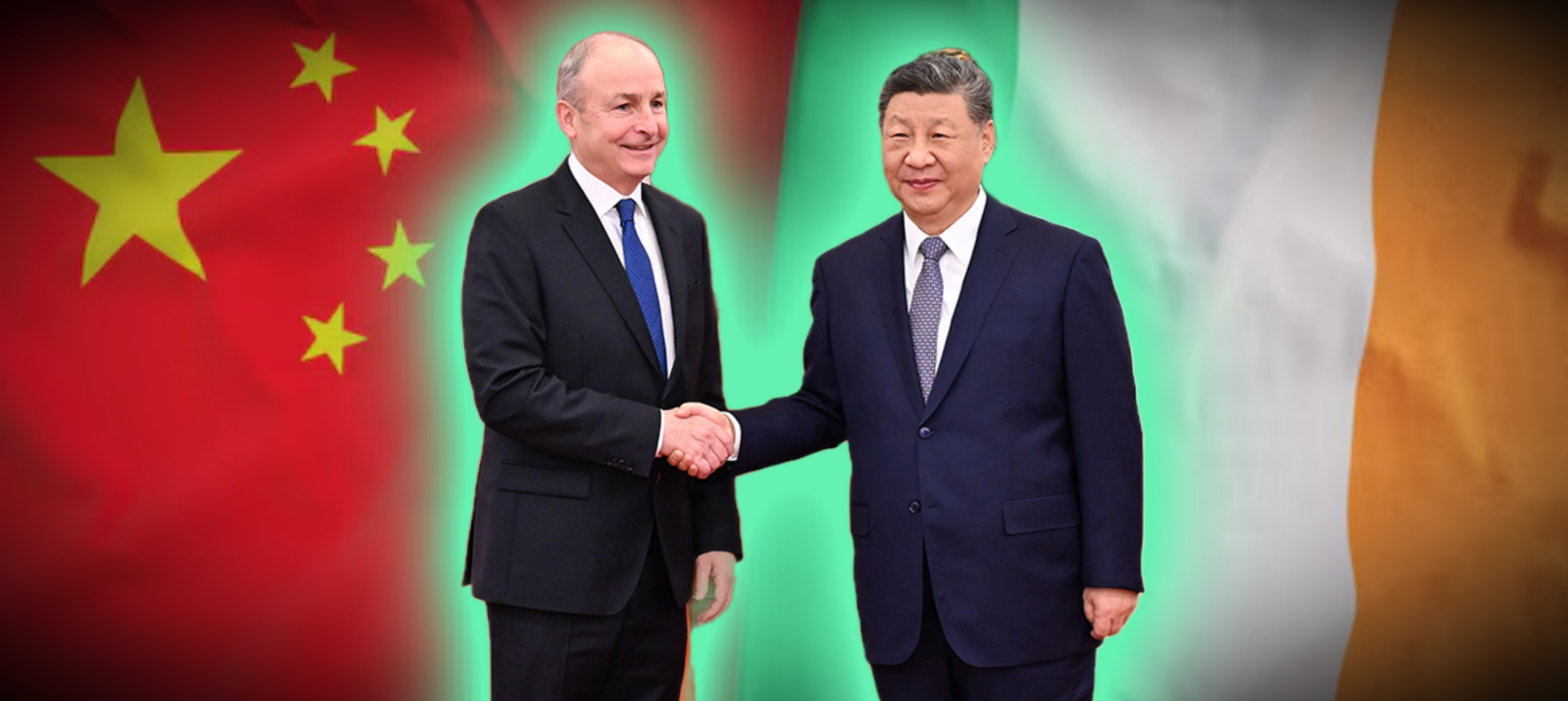
Taoiseach Micheál Martin arrived in Beijing on Sunday, January 4, for a five-day official visit—the first by an Irish prime minister in fourteen years. On January 5, 2026, he met President Xi Jinping at the Great Hall of the People.
President Xi highlighted the growth in bilateral trade and investment since the establishment of the Ireland–China strategic partnership in 2012. He emphasised mutual respect, multilateralism and constructive dialogue. Xi called for deeper cooperation in trade, artificial intelligence, the digital economy, healthcare, education, culture and tourism, as well as people-to-people exchanges, while encouraging Ireland to play a constructive role in EU–China relations.
Martin reaffirmed Ireland’s one-China policy, acknowledged China’s development achievements and reiterated Ireland’s commitment to strengthening both bilateral ties and broader EU–China cooperation.
The following day, the Taoiseach met Zhao Leji, Chairman of China’s National People’s Congress. Trade and agriculture featured prominently in discussions, with Martin stressing the importance of resuming Irish beef exports and raising concerns over provisional Chinese tariffs of up to 42.7 per cent imposed on certain EU dairy products in December 2025.
Pat McCarthy, Ireland Sino Institute, notes:
“The Chinese Communist Party constitutes the paramount political authority in China, while the National People’s Congress is the highest organ of state power and, in practice, occupies a secondary position within the overall political hierarchy.”
Education, Tourism and Cultural Exchange
Education formed a central pillar of the visit. Martin highlighted the depth of academic cooperation between Ireland and China, noting the existence of 13 joint colleges and approximately 110 joint programmes involving Irish higher-education institutions delivering teaching in China. He also witnessed the signing of more than a dozen new and expanded academic partnership agreements.
Last month, in an anonymous briefing to the Sunday Times, a senior figure in the Irish Military Intelligence Service suggested that Irish academic links to China could pose a security risk. The Taoiseach has defended Irish higher education institutions’ engagement with China, rejecting the suggestion that teaching Chinese students represents a security risk.
The Taoiseach later travelled to Shanghai, where he attended the signing of a new memorandum of understanding between Tourism Ireland and Trip.com Group, one of the world’s leading online travel platforms. The agreement strengthens cooperation in tourism promotion, digital outreach and data-driven marketing.
The Munster–Cork–China Connection
Cultural ties also featured prominently, with Munster—and Cork in particular—emerging as a recurring theme during the visit. While President Xi had visited County Clare in 2012 as Vice-President, Cork was central to this engagement, with the Taoiseach himself hailing from the city.
The Cork connection was further reflected through Pat McCarthy, a Cork native and Chair of the Ireland Sino Institute, who was invited to engagements during the Shanghai leg of the visit. McCarthy has been deeply involved in Ireland–China educational and cultural cooperation for many years and has worked extensively in China through non-profit education initiatives focused on rural communities.
During their meeting in Beijing, President Xi made a personal cultural reference, recalling that the Irish novel The Gadfly sustained him during difficult periods of his youth. Martin responded that the book had also left a deep impression on him as a young man. The novel carries a direct Cork connection: its author, Ethel Voynich, was born in Cork and was the daughter of mathematician George Boole, who taught at Queen’s College Cork, now University College Cork.
Together, these exchanges highlighted how Cork’s intellectual, cultural and civic links continue to shape contemporary Ireland–China relations, connecting national diplomacy with long-standing people-to-people engagement rooted in Munster.
A Human Dimension
The visit concluded with a reception in Shanghai attended by representatives from government, education and civil society. On this occasion, Pat McCarthy presented the Taoiseach with a plaque bearing the four-character expression Zǐ qì dōng lái (紫气东来) — “The Purple Qi Comes from the East.” In Chinese tradition, the phrase symbolises the arrival of wisdom, virtue and Heaven-sent good fortune.
The gift was presented on behalf of children supported through McCarthy’s non-profit school in rural Liaoning Province. Many of these children are disadvantaged, left behind by migrating parents or living with illness. When informed that the initiative had helped more than 50,000 rural Chinese children remain in education, Martin responded:
“I too began life as a teacher, and I once served as Minister for Education. I commend you for your work, and blessed are the children of rural China.”
A Calibrated Approach
Taken together, Martin’s visit formed part of a calibrated effort to advance Irish economic interests, support stability in EU–China relations and bring a measure of calm to an otherwise turbulent global environment. As Ireland prepares for its forthcoming EU presidency, the visit underscored Dublin’s intention to pursue a foreign policy rooted in engagement, balance and pragmatic diplomacy in an increasingly fragmented world.