
Reclaiming the Sartorial Soul: Clothing, Identity and Revival on the Celtic Fringe
This article was originally published on Culture Crusade’s Substack and is reproduced with the permission of the author.
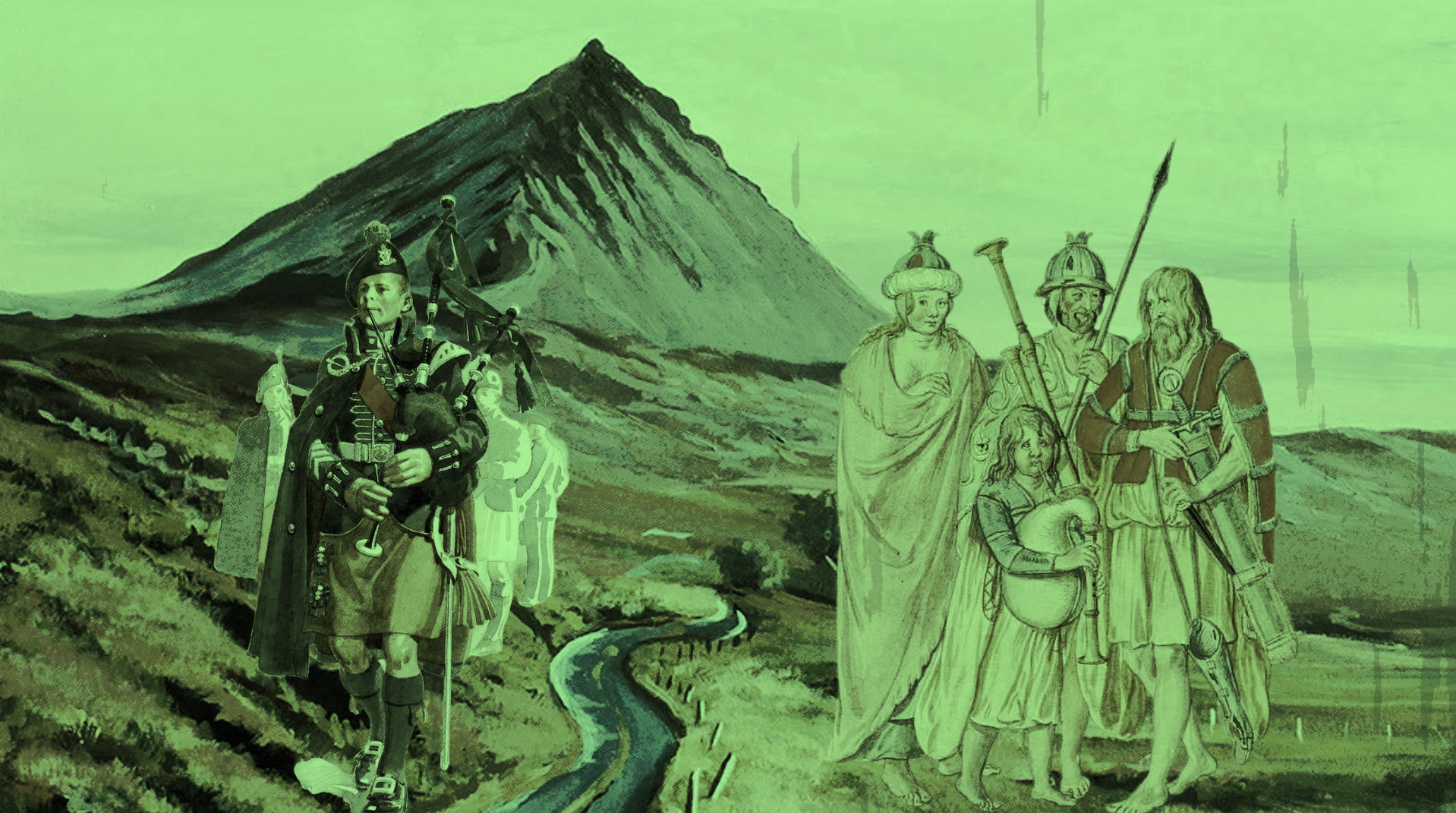
A Philosophy of Clothing?
Clothes are an underappreciated constituent of identity. They are the first signifier of cultural origin, social strata, and at times demarcate the friend/enemy distinction. Clothing even functions as the external extension of the wearer’s internal world: Before a word is uttered or language, accent, or intent are ascertained, what one wears is first in line for interpretation; at once a material necessity, symbolic language, and social instrument. They are the medium of first impressions, the most conspicuous sign of ethnic and religious affiliation, and even occupy a curious intersection of ethics, aesthetics, and politics. Their semiotic dimension makes for a rich source of meaning and displayed information -intentional or not- which can be read akin to a book. As French philosopher Roland Barthes argued, fashion is a signifying system where clothes speak, communicating cultural myths, values, and identities without words, and through garbs alone.
Moreover, not only do they speak to us, but they also have the uncanny ability to change us, and it is this alchemical quality of clothing that gives them such a fundamental and perennial role in human history, far beyond humble origins in shelter from the elements. As an accompaniment to identity formation, our sartorial extensions make us into something else, implicitly working on our character, as we might assume that authoritative discernment comes more naturally to the Judge in robes and wig rather than pyjamas. Clothing thus contains an ethical dimension in the sense that one’s attire is saturated with moral expectations. Ethical categories are expressible and enforceable through dress. Uniforms are a moralising force upon their wearer through a figurative subordination of the individual to their role. Military uniforms for the soldier, clerical vestments for the priest and Judicial robes for the judge all connote various moral imperatives crucial for those social roles, from gallantry, modesty, to integrity, respectively. They can also affirm a differentiated identity or indeed deny one. In this sense, dress is also a technology of power. This is a more obvious point where Ireland is concerned, one evidenced in the ample historical sumptuary laws which regulated who could wear what, with the ultimate goal of visually preserving or (more often) destroying social and national distinctions through fabric, form and colour. In an Irish context, the Tudor conquests of the 16th century involved attempts at imposing English clothing, as part of a ‘civilising’ project which hoped to change the essence of the wearer through a kind of sartorial metamorphosis; if an Irish Gael could be made to wear English clothes, his mind too might meld to English ways. As a consequence, political resistance often took sartorial form as many Irish of the period understood that keeping native styles while spurning foreign fashion went hand in hand with combating foreign domination.
While such history shows us how clothing could be on the frontline in a conflict for the preservation of different cultures, this remains a potential unfulfilled: sartorial over-coding of the Western world’s unique clothing cultures as they are steamrolled by the blights of sameness, mass production, and cheap, poor-quality items. What once delineated separate ethnic identities in a profound visual sense is now associated with its opposite, as every global denizen from Uganda to Korea dons a bugman graphic t-shirt for downtime or pulls out their suit for business affairs.
The suit itself is worth dwelling on for a moment as it says much about the mercantile essence of our late-stage civilisation. Though it has origins in other distant styles, the suit has effectively dominated as the uniform of the businessman, being adopted globally as the attire of the corporate and political worlds, and being iconic of bourgeois society in general. In fact, the suit developed in tandem with the emergence and consolidation of the bourgeoisie over the past two centuries, displacing aristocratic dress renowned for ornamentation, flamboyance and sumptuousness with the material ideals of the nascent business classes, something more sober and cosmopolitan. Moreover, the trend has only exacerbated, with the global standard for the highest formal expression in clothing being the ubiquitous suit of the mercantile class. Through this process of homogenisation, globalisation impedes the maintenance of authentic and distinct cultures that nurture their own material cultures and impress their unique spirit on the production of such items. In a sense, we don’t really have a material culture, if, as we do, we import masses of foreign garments and fabrics to the detriment of a national style, industry, and fabrics. Under the influence of global capitalism, insularity and the unique styles it foments are often the first casualties of the emergent global sartorial soup as we bear witness to all human cultures melding into a global polyester favela. While few antidotes to this trend are available to moderns, one beacon of hope is the survival of the old and distinct clothing forms in the ceremonial time capsule of national dress, and in this endeavour, the Gaelic nations are an instructive case study.
Historic Gaelic Clothing
While Ireland and Scotland are a small share of the European population, this has not prevented them from punching above their weight in cultural matters. Indeed, the Gaelic past holds a unique romantic sway over the imaginations of many people globally for a whole litany of reasons; yet one underappreciated cause is their striking aesthetic and creative choices, which, through the material conduit of clothing, acted as a canvas for the Gaelic mind. Interest in historic cultures is in part due to ethnic affiliation, but there is also a more universal aesthetic appreciation that draws us in. In fact, Western fascination with Japanese culture is largely due to this type of appreciation, and just as the land of the rising sun strikes a certain chord in these regards, so too does its Occidental counterpart in the Gaelic lands of the setting sun, where the historic dress is martial, flamboyant and bellicose and yet somehow graceful.
An interest in Irish national costume naturally follows from an interest in Gaelic history and identity, as it preserves vestiges of the latter into our own age. The clothing question, then, is aesthetically and politically intertwined and remains relevant to questions of identity and cultural revitalisation today. Engaging with national costume should not be confined to academic investigation or reenactments for history’s sake alone, though those elements are also crucial. If, for example, the reassertion of an Irish identity requires crucial revivals of the Gaelic language, Gaelic games, and a broader Gaelic weltanschauung, then what possible rationale do we have for the neglect of Gaelic clothing?
After all, clothes are one of the first things that come to mind when we invoke a particular past civilisation. As much as Rome conjures up the image of marble pillars and raucous amphitheatres, it also brings to mind the tunic-clad Roman strutting the cobbled streets of the eternal city. Gaelic civilisation, in turn, conjures vivid images of rugged castles and wind-swept glens, but are we to ignore the concomitant images of equal force in the leine-clad kern or great-kilted highlander? Moreover, how can this fact not manifest an acute anxiety when we wonder what the future generations will think of when they think of 21st-century Ireland? To our eternal shame, is it not currently Polyester North Face jackets, Nike Air Max, and yoga pants, all spewed out of the industrial bowls of a distant Orient? If such a regrettable and frankly obscene state of affairs is to be avoided, some degree of a sartorial revival vis-à-vis a national costume or inspirations therefrom will be required. Seeing as flatcap nationalism won’t cut it (they are ultimately of northern English origin), nothing short of a thorough, bordering on pedantic (mea culpa), review of Gaelic clothing history will suffice.
There are two points worth noting at the outset of this analysis. One is that despite the many centuries of change in Gaelic clothing, there are some enduring items which make speaking of Gaelic clothing a meaningful concept, i.e. a somewhat stable endeavour rather than fluctuating pastiches with no historico-sartorial ‘there there’. Thus, when speaking of Gaelic attire, we generally refer to the four staples of Gaelic garments: the léine, the ionar, the trews, and the brat, notwithstanding the very significant developments in their style and shape from the early medieval to early modern periods.
Secondly, speaking for the most part about ‘Gaelic’ dress without the usual Hibernian/Caledonian dichotomy is a coherent choice until the early modern period, as Gaelic dress in Scotland and Ireland was practically identical up to that point. Indeed, from medieval times until the 17th century, the national costumes of both countries were essentially indistinguishable to the point where continental observers often confused highland Scots with Gaelic Irish or vice versa, or even used them interchangeably. McClintock, renowned author of the seminal tome on Gaelic dress, Old Irish and Highland Dress, opens the work with an apt verbal flourish that, ‘It is all part of the one story though worked out in different lands, like a river which before its end has divided into two channels; and it should be regarded as such. If the Irish section is longer than the Scottish one it is only because the information about Ireland turned out, rather unexpectedly, to be the more abundant.’
McClintock’s tone here is one of surprise, which itself exposes certain assumptions about the sartorial inheritances of both countries. For instance, while held to be true of Celtic nations broadly, it is Scotland that is perceived as most sartorially distinct and the keeper of more archaic dress forms than her Irish neighbour, and it is one of the strange vicissitudes of history that the former’s national costume has risen to global recognition while the latter dwells in obscurity by comparison. This trend largely explains McClintock’s surprise in the previous quote, as one would expect the greater material to be on the Scottish side. But that is not the case, and one wonders why that might be?
While Irish Gaelic dress may have been de jure banned after Henry VIII’s sumptuary laws, it was de facto in use until the mid to late 17th century. This is not unlike Scotland’s 18th-century sumptuary crackdown, which saw legal restrictions placed on Highland dress after the defeat at Culloden. Though common knowledge imagines the demise of Irish Gaelic dress as a 16th-century phenomenon, this is completely false, given the ample evidence of it being a part of Gaelic society well into the latter stages of the 17th century. One obvious proof of this is the striking portrait of Owen Roe O’Neill’s bust, his fresh aristocratic visage framed by the shaggy Irish mantle that adorns his shoulders.
Before we go on, I will first flesh out the four garments that were prominent in Gaelic society through the Middle Ages and into the early modern era. From the earliest times, both a brat and a léine were the primary items worn by the Gaels. The léine was a long linen tunic which could come in different colours (white and off-white were common, but other colours are attested), though a yellow hue came to dominate from possibly as early as the 15th century. This yellow colour, made using saffron dye and possibly other native dyes, created the infamous ‘saffron shirt’ which the English commentators were keen to comment on or criticise. The shape of the léine fluctuated somewhat over the centuries, with the most notable alteration occurring in the 1400s, when long, hanging sleeves were added, giving it a striking, exotic look that still impresses today when moderns look at 16th-century watercolours of Irish warriors such as those by Lucas de Heere and Albrecht Dürer.
The Brat or Irish mantle was the other Gaelic staple of equal antiquity, being worn like a large cape, with the corners fixed around the shoulders using a brooch (there were no doubt changes to how it fitted over the centuries). This item was made of wool and used as the primary shield from the elements. Irish mantles were even prized outside of Ireland for their quality and ability to keep their owner dry and warm in the most severe of conditions. They were also some of the most colourful parts of Gaelic clothing, coming in many shades and often multi-coloured in what the Gaels called ‘breacan’, meaning they were often checkered or tartan. The Brat also featured decorative fringing all around its border, which is one of the more notable features in the watercolours.
Though the Léine and Brat formed the basis of Gaelic dress, trews (Triúbhas) could also be worn, though they were clearly optional given the preponderance of bare legs in the Gaelic world. These too had different styles, with many being skin tight through their entirety, while others were tight from foot to mid-thigh, with a looser upper section. Many had stirrups to prevent them from sliding up. Trews, like the Brat, were often adorned with contrasting colour; the fitted portion commonly featured simple checks or tartan as seen in both the Killery and Dungiven trews. The last item of note is the ionar, a short jacket with open sleeves to display the léine’s hanging sleeves (common from the 15th and 16th centuries), richly ornamented with pleats, piping, and often decorated coloured designs from swirls to medieval style foliage.
From Kilting to Kilts
Irish kilts are an infamous source of contention, with many historians rubbishing the notion entirely. But the question of its authenticity is more complex than the nay-sayers care to admit. Historically speaking, and if we might split etymological hairs, the word kilt was initially more verb than noun. The term has a deceivingly short and culturally loaded usage. It is not a Gaelic word of antiquity, but is rather a loan word into Scots from Middle English, which in turn was derived from Old Norse. To kilt meant to tuck/belt/fold up, in the sense that a long garment, such as a léine or brat, could be secured in such a fashion that it was brought above knee height and did not encumber the wearer during strenuous activity, be it running or warfare. Kilting, understood as such, can be seen in several Irish contexts, as in the 16th-century depictions of De Heer’s watercolours, where the Irish soldier has clearly tucked up and belted their léine. The ultimate effect is to make it skirt-like in appearance, hanging above the knee and exposing much of the leg, quite similar to the proportions and silhouette of what the modern conception of a kilt is, though of course the léine is a full body garment, not merely for below the hip.
The kilt itself, as it is understood today, is in one sense at least an invention of modernity. It is an alteration to the structure of the feileadh-mór (great kilt or literally the great wrap), essentially removing the part of the massive, tent-like brat that was on the upper body, simply to maintain the pleated skirt-like shape of the lower body section. By the Tudor and Stuart eras, the brat was increasing in size to the point where, in Scotland, it became common practice to belt it around the hip and pleat it to manage its size, a size that by the industrial age had become an issue.While there is some contention as to the source of the amendment, the most accepted account is actually that of an English businessman, Thomas Rawlinson, who wished to make the labour of his highland employees less encumbered in an industrial setting by the full great kilt, thus innovating what we see most Scots wearing today. This process mostly explains why the essence of the term kilt has come to mean the skirt-like item hanging from the waist to the knee.
Given the kilt or feileadhbeg’s origin in the great kilt and its relation to the action of tucking up or ‘kilting’ so that a larger garment finished higher on the knee, allowing movement, it becomes difficult to hold the term exclusively for the Scottish kilt. Hence, we arrive at the primary problem with denigrating the use of an Irish ‘saffron kilt’, as it is an arbitrary semiotic tethering that favours a Scottish exclusivity and ignores the etymological root in the act of tucking up indelible to both the léine and feileadh-mór.
19th-century Irish scholars Eugene O’Curry and P.W. Joyce were among the first to advocate for an Irish kilt, albeit based on primary sources that were often ambiguous. They noted that descriptions and depictions of the léine or léinidh frequently showed a knee-length garment that, when belted, appeared gathered or pleated and visually resembled a short skirt—especially in art on high crosses, shrines, and manuscripts. McClintock, writing in the 20th century, critiqued both from the position of the stricter modern definitions of “kilt” versus tunic and a comparative analysis. O’Curry and Joyce, however, operated without such rigid categories; the belted léine could genuinely look and function like a kilt in many contexts.
If the filleadhbeg derived from an amended great kilt can be called a kilt, then this is a category that must include the amended léine, which is the Irish saffron kilt. If the kilt is the genus, then both Irish and Scottish styles are species.
Furthermore, if the Scottish kilt is the 18th-century amendment to the feileadh-mór to give a skirt-like simplicity to a previously larger garment, then the 19th-century amendment to the léine resulting in the ‘saffron’ or ‘Irish’ kilt is no less authentic, unless one really wants to quibble over a 100-year gap from Rawlinson’s amendments to the adoption of the Irish kilt (O’Curry and Joyce). If it is valid for a Scottish national costume to alter and popularise traditional Gaelic clothing, then it certainly holds for the Irish too.
That the kilt remains perceived as a timeless Scottish ur-garment is a testament to the mostly post-medieval reconstructions of romantic nationalism by way of Walter Scott. The roaring success of his endeavours has meant that the kilt is treated as something exclusively Scottish, effectively a proprietary term, insinuating that all knee-length Irish garments are derivations of their Scottish counterparts instead of parallel survivals or revivals. The kilt’s semantic scope should include such garments rather than its use for obtuse cultural gate-keeping against Celtic neighbours. Intellectual consistency should include the saffron kilt as an Irish variant of a legitimate and historically grounded expression of the same broader tradition of knee-length garments – sharing visual, functional and historical affinities with the great kilt, being belted and pleated.
In truth, the Saffron kilt is more of a composite of traditional Gaelic dress rather than a literal medieval item, and this is not necessarily a mark against it, as it is not against the kilt in Scotland. Demanding a full rendition of authentic medieval and early modern Gaelic clothing when we struggle to get large swathes of the population out of tracksuits is, at best, putting the cart before the proverbial horse; at worst, completely undermining any attempts at reviving recognisable Gaelic garments that aren’t solely confined to ceremonies, parades, and reenactment sites.
The Tussle Over Tartan: A Shared Gaelic Heritage?
The kilt is not the only Gaelic clothing to become an ostensible proprietary item linked with Scottish Romanticism: Tartan, too, has come to occupy such a position. Take, for instance, McClintock’s strong association of tartan with Scotland, which is fair to assume in the modern period, but does not necessarily hold when one looks deeper through the centuries. The following is an account of the appearance of Irish soldiers on the continent in the mid-17th century:
Translation :—
1654. In the same autumn, Philip O’Reilly, a colonel of our nation,
with about 1,000 Irishmen under his command, most of them of his own
people or devoted to him, landed from Spain (whither in the previous year
we saw him to have sailed), in Belgium and there served under the king of
Spain, every one looking with wonder at the men of that regiment,
brawny, bony, sinewy, most sturdy fellows, born to warfare and by that
time veteran soldiers, clad after the ancient fashion of the Irish in tight
breeches and cloaks for the most part parti-coloured, reaching to the heels.
Soon after their arrival, as Condé was one day reviewing them with
admiration and examining them company by company, when he came to
the guard of the regimental colours, the sentry levelled his great pike in a
threatening way at Condé’s breast, and told him in the Irish language
to come no nearer. Seeing this, the prince bid James O’ Dempsey, the Irish
major, ask the man what he meant. To James’s question’ the other
replied: ‘‘ A prince that has followed the profession of arms so many years
should know that even friends are not allowed to come up to the regi-
mental colours until they have asked and obtained permission.”
McClintock conjectures that by the description of tartan, the soldiers described are likely to be Hebridean (92). Why would one assume that? Here we have a vivid description of the Ulster soldiers who are uniformly clad in ‘tight breeches and cloaks’ of diverse colours, very likely references to what the Gaels called breacan (‘tartan or tartan like’) patterning. McClintock has set up a dichotomy of Scottish tartan versus Irish block colours, which does not hold up to scrutiny. Tartan or more broadly breacan, which includes anything parti-colored, checkered, speckled or variegated, was certainly in use in medieval Ireland as well as in Scotland. Checkered patterns are attested in the illustrations of the Book of Kells, the account of Cambrensis during the Norman invasion, and evidenced by some fortunate textile survivals such as the checkered Killery trews pulled from a bog in Sligo and the striking ‘true’ tartan of the Dungiven trews from Antrim. Frustratingly, these have not been carbon-dated, but the Killery costume has been variously dated through stylistic analysis from as early as the 15th century all the way to the 17th. Yet the significant similarities of the coat with the Gaelicised figure of Noah in the Book of Ballymote circa 1400 mean that a 15th-century origin for the killer trews is very plausible. The Dungiven trews are estimated to have a late 16th-century or early 17th-century date. Though archaeological textile expert Audrey Henshall believes the tartan trews are very similar in construction to other extant Irish trews, such as the Kilcommon trews, this has not stopped a hasty presumption of Scottish origins for the garment, despite the find being in O’Cahan territory of the time and being in accord with the descriptions of Ulster Gaelic soldiers from the period.
Much of this reflexive attributing of Scottish origins is no doubt a consequence of Walter Scott, who, with his 19th-century romanticism, did much to ostensibly patent tartan for Scotland, inventing clan tartans and giving Scottish costume popularity through his extensive curation of George IV’s visit to Scotland in 1822. But the fastening of tartan to Scottish identity, at a relatively late date, tends to ignore the textual, illustrative, and archaeological evidence of its use in Ireland. While Irish county tartans are indeed a 20th-century invention, so too are the Scottish clan tartans of the 19th century. Rather than assuming the tartan pattern came to Ireland via Scotland, the oldest surviving true tartans from both countries are roughly contemporaneous, with the Dungiven trews and the Glenaffric find both likely originating in the 16th century, although we still await a definitive scientific dating for the former. Given the ample evidence checkering in the Irish sartorial record going back centuries before this, it is not unreasonable to assume that more complex ‘true tartan’ patterns would have developed slowly over time. The occasional early source even hints that the textile influence of early tartan was the other way around. Remarking on Highland dress, Camden, writing in his 1607 Britannia, states that “The wild Scots are clothed after the Irish fashion, in striped mantles, with their hair long and thick.” Moreover, striped mantles and mantles of various colours are mentioned or depicted from The Táin to the 17th century. German illustrations of a procession of Irish papists in Stuttgart in 1617 show striped mantles and hats, which, though emphasising horizontal stripes, may be the artist’s attempt to portray crude tartan patterns (p.58 McClintock). A much more likely candidate for the illustrative depiction of tartan is in Speed’s Wilde Irishman, which has a richly decorated brat in patterns that are striped in many directions, though not as formal as the modern tartans we have become used to. Speed’s illustration is also interesting for the similarities of the brat to another illustration of a Scottish highland Gael from a French artist some decades earlier. McClintock was perhaps too quick to dismiss these images; the French depiction he thought was too fanciful in parts to be accurate, and that Speed’s was an imitation of it. However, there is simply a lot of conjecture here, and even if parts of the Scottish Gael are fanciful, the only uncanny similarity between the two is of the brat, which is just as likely to represent the same decorative trends amongst Irish and Scottish Gaels as it is painters copying each other. All in all, there is plenty of evidence to point to a shared tartan heritage between the Gaelic kingdoms, even if Scotland deserves much credit for maintaining it longer, and developing it at scale– neither of which should stop an Irish state from seeking the revival of a native tartan textile industry on a par with Scotland’s.
Revivals and Authenticity: Living Tradition or Ossified LARP?
Contrary to the trope of Henry Tudor (VIII) killing Irish Gaelic fashion, it is clear from the aforementioned accounts that a distinctly Irish style of dress was alive and well in the 17th century, and that the line of tradition was not as broken as once assumed, if, as the account of the Ulster veterans in the late 17th century shows us, the Irish style was strongly maintained among the vestiges of her Catholic Gaelic soldiers who likely saw service in the Cromwellian wars. Indeed, the gap between these last reports and the mid-19th-century take-up of the saffron kilt is a gap of merely 150 years, and when one considers that this gap did not feature a complete paucity of Gaelic styles either. The brat may even have persisted in some derivative form in rural areas and isolated fishing communities. The Kinsale cloak and various Irish shawls were distinctively Irish adaptations that absorbed and localized broader European fashions while retaining the practical draped-wool outerwear role of earlier mantles. Indeed their very popularity in Ireland shows that the functional draped tradition of the medieval brat never fully expired, as regional hooded cloaks and shawls succeeded them in everyday use and remained prominent, especially in the west of Ireland (Galway and Cork in particular). The point here is that we certainly have the makings –fractured as they are– of a living tradition that needs more a breath of new life than a total reconstruction ex nihilo; an important point when it comes to questions of authenticity.
The gradual loss of distinctly Irish Gaelic clothing has been a recurring source of lament for Gaelic intellectuals from their eclipse in the 17th century right up to the 20th century, as its return was viewed as a necessity for the eventual fulfilment of Gaelic freedom. Gaelic poets of the 17th century told their people that ‘they would never have luck or happiness until they returned to the customs of their ancestors or until farmers dressed again in trews, mantles, caps and soleless stockings’, thereby making a striking link between native attire and native freedom. Taking a similar sentiment into the 20th century, Padraig Pearse and Thomas Ashe were advocates of national costume revival, with Pearse famously adopting the saffron kilt for his students in St. Enda’s, preferring them to the trews, which he thought were too comical-looking. They were, in turn, building off the work of academics Joyce and O’Curry, who advocated for the existence/revival of the ‘Irish kilt’ based on etymological and anthropological findings that many, including McClintock, find contentious.
Regardless, some revivalist successes must be conceded in the fact that national costume has settled into the familiar sight of Irish pipeband uniforms that frequent marches, state events, games, and Irish military parades, consisting of saffron kilts paired with green or black jackets and sometimes a brat-like cloak. While objections to this particular pastiche are not uncommon, many of the amendments made to arrive at this quasi-national costume, which takes some cues from its highland cousins but certainly consciously maintains particularly Irish Gaelic elements, are ultimately defensible as they provide a sort of brand recognition, and can itself be amended without starting from scratch. Indeed, amendments are an essential part of retaining sartorial and cultural continuity by keeping archaic elements alive through requisite adaptations to modern life; For is it not self-evident that a living, if ‘modernised’ tradition is better than a dead cosplay?
Absolutist notions of integrity when it comes to national costumes fail to entertain that these are ultimately living traditions, a failure of judgment that eventually costs the very tradition that they purport to protect dearly. Ironically, such purism is at least partly responsible for the failure to cultivate an Irish national dress at scale, or at least at the Scottish scale.
Incorrigible insistence upon the suspension of the national costume at one particular point in Gaelic history causes more issues than it solves. A tradition kept alive, albeit with some compromise with modernity, is worth much more than a broken chain. Such broken chains compel nations with irredentist sentiments to reestablish tradition with a concomitant overcompensating zealousness that hurts the long-term tenability of the project (seen in abundance in the attacks on the saffron kilt). This trend has not been without its consequences in Ireland, where donning the saffron kilt as the inheritor of léine croich remains to many people akin to cultural LARP, whereas the Scots, embalmed in the legacy of Walter Scott’s caricaturing and propagandising of highland dress, exist as the fish in water, not perceiving anything alien, inauthentic, or anachronistic in their kilt-wearing habits. Had Ireland simply leaned into the kitsch all those years ago, we may well have more omnipresent national dress on a par with that which Scotland enjoys today.
Scottish national dress enjoys the benefits of a cultural and economic inertia that drives the tradition on. Buttressed by a confluence of reinforcing factors, from a heavily protected and state-backed tartan industry, to a capital R- romanticised national identity augmenting the tourism economy, Scotland pays no heed to a stultifying scepticism or purism on the matters of national dress, and a 16th-century carbon dating for the Glenaffric find or 19th-century origin for clan tartans proves no impediment.
With this in mind, one cursory survey of the saffron kilted pipe bands that form the vanguard of Irish national costume is that the saffron kilt itself is fully embracable for the many reasons previously pointed out. Sporrans, or tartan-patterned kilts, on the other hand, might be spurned if one wants to avoid exclusively highland items (not that all cultural cross-pollination should be rejected). The fly plaid, which, when it appears, is often also saffron in Irish piping bands, could remain due to evoking the extensive area of the old léines, which once enveloped the wearer from shoulder to knee. The better option, however, would be to replace the fly plaid outright with an actual Irish mantle (brat) tailored in style and colour to the needs and context of the wearer for their regiment/band/even wedding. In fairness, such cloaks which emulate the brat have been employed by several different Irish pipebands, including the Royal Irish Rangers (objections to Irish regiments in the British army notwithstanding). These cloaks, or rather brat derivatives, add a uniquely Irish look to many pipebands as a suitable accompaniment to the signature saffron kilt, yet they tend to be exclusively black or green. Alternatively, such cloaks could provide the opportunity to display the colourful brats of Irish yore, with tartan or checkered patterns making their presence known again on the piper’s back.
The trews would be a welcome staple to see returned, but are admittedly less striking to the modern eye than the other parts of the national costume.
Moreover, one advantage of the modern kilt over items, including its genealogical forefathers like the great kilt or léine, is its easy incorporation into other sartorial styles. The kilt is seamlessly worn with shirt and jacket at countless weddings and banquets every year, a feat that would be difficult, if not farcical, to attempt in the léine or feileadh mór. In fact, when paired with particular types of jackets, the overall impression from the silhouette harkens back to some older depictions of the Gaels wearing an ionar, and some basic embroidering of such modern jackets could enhance the likeness greatly. Working with the saffron kilt –rather than insisting on the return of a full léine– lends a practicality and versatility that should be leaned into and accepted as required innovation rather than outright condemned as an inauthentic deviation. Furthermore, in doing so, Gaelic dress becomes/remains a living style rather than an ossified LARP. It also maintains the bare-leggedness so infamously fond to the Gaels through the centuries with its silhouette finishing at the knee, a wilful exposure of stout limbs. Indeed, there is certainly a very Gaelic fondness for leaving the legs exposed, an atavism that may well live on in the ubiquitous O’Neills shorts of contemporary Ireland, comparatively (scandalously?) short by European standards. Avant-Garde fashionista Paul Mescal, who brought international renown to the short shorts, may well be the unwitting exponent of an ancient blood memory..
Reclaiming Gaelic Irish Dress
In summing up the saga of our national costume, one cannot help but get a sense of the scale of the loss that was the erasure of the native fashions. Their passing into history has left us ostensible artefacts that the nation has struggled to maintain, their fate being even more dire than that of the language. The loss is hard to put into words, but something suitable is evoked by the words of G. A. Hayes-McCoy in his book on the Nine Years’ War. Commenting on the destruction of the Gaelic order and the ‘what ifs’ it has left us, he leaves us with two striking quotes about the adaptability and innovation of the Gaelic Ulster Army. He posits the Ulster army at the dawn of the 17th century to be among ‘the very best of the old Irish civilisation. An order of life that could produce such an organisation as the Ulster army gave much promise for the future, for it was at once adaptable and strong in its heritage of the past.”(6) “Thus is added one more piece of evidence to what we know of the distinctive character of native Irish society before the Tudor conquest steamrolled institutions, costumes, weapons and everything else into the flat pattern of an interpreted internationalism.”(26) It was such internationalism that began the decline of Gaelic power, and thus clothing all those centuries ago, and much of the same forces are arrayed today to add the final nail to the coffin.
Just as learning Irish is a statement in stemming the tides of this destruction, choosing to wear a national costume, then, is also a statement about one’s relationship to one’s culture and their will to preserve it. The wearer is doing the inverse of the omnivorous devourer of fashion, as fashion is always future-oriented, constantly in flux, and pushed along by the will to be the next new thing in a ceaseless vortex of trendsetting. The wearer of a national costume, in effect, engages via the identity technology of clothing, in an act of cultural affirmation; consciously re-presenting the past and bringing it into the future on their terms, making the wearer part of a continuity that gives them one foot planted in their unique history, bringing with it a deeper sense of identity and difference. Hence, ceremonial environments, where the invocation of the past is more explicit and expected, such as military parades, Gaelic games, and even weddings, are the most suitable places where modern incarnations of Irish Gaelic dress can manifest, and this deserves every encouragement. Advocacy of our culture takes place in many domains, and the visual space of national clothing, despite the efforts of Pearse, Ashe, Joyce, and O’Curry, has been underutilised. Let us then be the generation to recover the sartorial soul of Ireland.
Bibliography
Dunlevy, M. (1989) Dress in Ireland. London: B.T. Batsford.
Giraldus Cambrensis (c. 1188) Topographia Hibernica. (O’Meara, J.J. (ed. and trans.) (1982) The history and topography of Ireland. London: Penguin.)
Joyce, P.W. (1906) A smaller social history of ancient Ireland. Dublin: M.H. Gill & Son.
McClintock, H.F. (1943) Old Irish and Highland Dress. Dundalk: Dundalgan Press. (2nd enlarged edition 1950)
O’Curry, E. (1873) On the manners and customs of the ancient Irish (3 vols., ed. W.K. Sullivan). London: Williams and Norgate.